
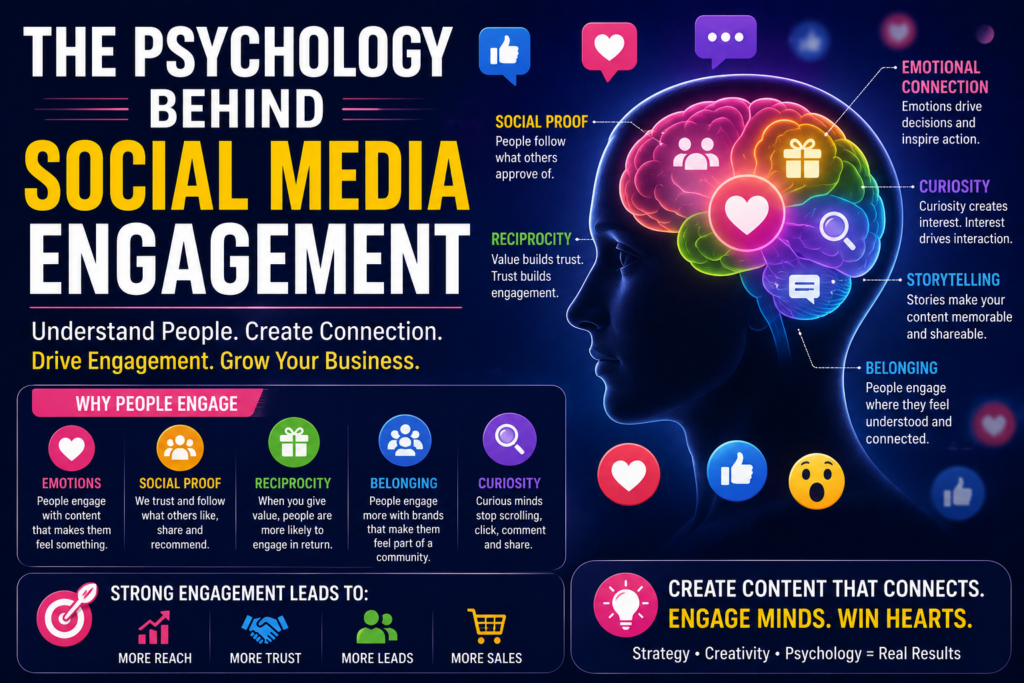
Why do some social media posts get thousands of likes, comments, shares, and saves while others barely receive any attention? The answer isn’t always better graphics, larger budgets, or more followers. More often, the difference lies in understanding the psychology behind social media engagement.
People don’t engage with content randomly. Every like, comment, share, and click is influenced by human emotions, behaviors, and psychological triggers. Businesses that understand these triggers can create content that resonates with audiences and generates meaningful interactions.
At Adblink Digital, we help brands develop data-driven social media strategies that connect with audiences on a deeper level. In this guide, we’ll explore the psychology behind social media engagement and how businesses can use these insights to improve their online presence.
What Is Social Media Engagement?
Social media engagement refers to how users interact with your content.
Common engagement actions include:
- Likes
- Comments
- Shares
- Saves
- Story replies
- Direct messages
- Link clicks
High social media engagement signals that your audience finds your content valuable, relevant, or emotionally compelling.
Platforms like Instagram, Facebook, LinkedIn, and TikTok often reward engaging content with greater visibility and reach.
Why Social Media Engagement Matters
Many businesses focus solely on follower counts.
However, engagement often matters more than audience size.
A highly engaged audience is more likely to:
✔ Trust your brand
✔ Visit your website
✔ Become customers
✔ Recommend your business
✔ Return for future purchases
Strong social media engagement creates relationships, not just impressions.
The Psychology of Human Attention
Social media users are exposed to thousands of pieces of content every day.
To stand out, your content must capture attention quickly.
Psychologists often refer to this as the “attention economy.”
Users typically stop scrolling when content triggers:
- Curiosity
- Emotion
- Surprise
- Relevance
- Personal interest
That’s why headlines such as:
- “You’re Making This Marketing Mistake”
- “Most Businesses Don’t Know This”
- “The Hidden Reason Your Website Isn’t Converting”
often perform well.
They create curiosity gaps that encourage engagement.
Psychological Trigger #1: Emotional Connection
People engage with emotions before logic.
Content that evokes emotions often generates higher social media engagement.
Examples include:
Inspiration
Success stories motivate audiences.
Happiness
Positive content encourages sharing.
Surprise
Unexpected facts capture attention.
Empathy
Relatable content creates connection.
Fear of Missing Out (FOMO)
Limited-time opportunities encourage action.
The stronger the emotional response, the greater the likelihood of engagement.
Psychological Trigger #2: Social Proof
Humans naturally look to others when making decisions.
This psychological principle is called social proof.
Examples include:
- Customer testimonials
- Reviews
- User-generated content
- Case studies
- Success stories
When people see others engaging with your brand, they’re more likely to trust and engage with it themselves.
Social proof significantly improves social media engagement and conversion rates.
Psychological Trigger #3: Reciprocity
People often feel compelled to give back when they receive value.
When brands consistently provide:
- Helpful tips
- Free resources
- Educational content
- Useful insights
Followers are more likely to engage in return.
This principle is one reason educational content performs exceptionally well on social media.
Psychological Trigger #4: Belonging and Community
Humans naturally seek connection.
People engage more with brands that make them feel part of a community.
You can encourage this by:
- Asking questions
- Creating polls
- Starting discussions
- Featuring customer stories
Community-focused content often produces stronger social media engagement than promotional content.
Psychological Trigger #5: Curiosity
Curiosity is one of the most powerful engagement drivers.
Examples include:
- “The Marketing Secret Nobody Talks About”
- “You Won’t Believe What We Discovered”
- “Here’s Why Your Competitors Are Winning”
Curiosity encourages users to stop scrolling and interact with content.
However, curiosity should always be supported by genuine value.
Interactive Social Media Engagement Quiz
Answer YES or NO:
Does your content:
- Tell stories?
- Trigger emotions?
- Include customer testimonials?
- Ask questions?
- Encourage comments?
- Offer useful tips?
- Use strong hooks?
- Create curiosity?
Why Some Posts Go Viral
Viral content often combines multiple psychological triggers.
Successful viral posts typically include:
✔ Emotional appeal
✔ Strong relatability
✔ Social proof
✔ Shareability
✔ Simplicity
People share content that reflects their identity, beliefs, or experiences.
Understanding this behavior can dramatically improve social media engagement.
The Role of Storytelling
Stories are one of the oldest forms of communication.
Our brains naturally process stories more effectively than facts alone.
Instead of saying:
“Our client increased sales by 50%.”
Tell a story:
“Three months ago, our client struggled to generate leads. Today, they’ve increased sales by 50%.”
Stories create emotional investment and stronger audience engagement.
Why Educational Content Performs So Well
Educational content satisfies a psychological need for learning and self-improvement.
Examples include:
- Marketing tips
- Industry insights
- Tutorials
- Step-by-step guides
Educational content often receives:
- More saves
- More shares
- Longer engagement
This is why businesses should balance promotional content with value-driven content.
Common Social Media Engagement Mistakes
Posting Only Promotional Content
Constant selling reduces engagement.
People follow brands for value, not advertisements.
Ignoring Audience Interaction
Engagement is a two-way conversation.
Replying to comments and messages strengthens relationships.
Lack of Consistency
Inconsistent posting weakens audience connection.
Generic Content
Audiences engage more with authentic and original content.
How to Improve Social Media Engagement
Create Better Hooks
The first few seconds matter most.
Examples:
- “Most businesses get this wrong…”
- “Here’s what nobody tells you about marketing…”
Ask Questions
Questions naturally encourage interaction.
Use Storytelling
Stories increase emotional connection.
Encourage Participation
Use polls, quizzes, and discussions.
Deliver Consistent Value
Educational and entertaining content builds trust over time.
How Adblink Digital Helps Businesses Increase Social Media Engagement
At Adblink Digital, we help brands create content strategies designed around audience psychology.
Our services include:
- Social media management
- Content strategy
- Audience analysis
- Engagement optimization
- Paid social advertising
- Brand growth campaigns
Our goal is simple:
Create meaningful engagement that leads to real business growth.
Final Thoughts
The secret to successful social media marketing isn’t simply posting more content.
It’s understanding people.
Every like, comment, share, and save is influenced by psychological principles that drive human behavior.
By understanding the psychology behind social media engagement, businesses can create content that captures attention, builds trust, and encourages meaningful interactions.
The brands that understand people will always outperform those that only focus on algorithms.
Ready to increase your social media engagement?
Contact Adblink Digital today and discover how psychology-driven marketing can help your business grow online.